When describing the transition from a technology service to a digital service, I’m often heard to say: “digital is 10% technology, 90% psychology”.
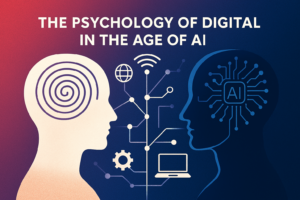
What does this mean in practice in terms of how we work and our approach? It means that we start by focusing on the outcome that we want to achieve rather than the technology that we want to implement. It means that we try to establish the underlying needs of people that we’re trying to meet. We consider human behaviour and how it affects how people interact with our services and the technology we use. Technology alone will never solve problems for us, make our work more efficient or improve the quality of our services. It only works when considered in the context of process and behavioural change that is required to adopt it.
An example I often use is in the case of a government department when I was tasked with understanding why the implementation of a new system wasn’t generating the efficiency savings that had been predicted. The requirement gathering had been precise and thorough. There had been time and motion studies and almost all the process had been automated, however, when I observed the staff using the new system, I discovered that they were still performing some of the steps in the old process. Despite the automated flow, staff were screenshotting emails and saving them in a folder. Along with a user researcher, I spoke with them and we soon discovered that there was a lack of trust in the new system. A lot of the steps were completed in the background with no visibility. Staff were worried that there was no audit trail and that they could be blamed for making the wrong decision if there was no evidence. The problem wasn’t the technology. It was the culture of blame. We were able to implement a checkbox that was far quicker to complete than the email palaver. This met the underling need of reassurance.
The psychology of digital has never been more important than now, in the age of AI. There are countless examples of where AI has proved to be far more reliable than humans in performing certain tasks, but people don’t trust it. It is somehow more palatable to accept human error than that of machines. We should never disregard this when designing AI solutions. It may not be a technical requirement, but the human need is just as important. We should never only consider the accuracy of AI models when evaluating its success.
In the public sector this is more important than anywhere else. Klarna replaced their customer services staff with AI in early 2024. If their customers feel uncomfortable about the use of AI in their interactions, they can choose not to use Klarna and Klarna can decide whatever makes commercial sense. However, if we did the same,
our residents don’t have the luxury of choice. There is only one Essex County Council they can engage with.
This is why we have chosen to take a considered, responsible approach to our rollout of AI. We have had considerable success with the use of Co-Pilot to help our staff with some of their day-to-day tasks. We have automated some repeatable, robotic processes and we are testing other use cases. However, our AI is “human in the loop”. We are using it to augment decision making rather than replace the humans making the decisions. And we are designing our strategy with our residents and learning about their feelings towards AI so that we can make sure we are meeting all their needs. Not just the technical ones. * This blog post was written without the use of AI
Essex residents are invited to take part in our research about the use of AI:
Come and chat to us about your thoughts on the use of AI in public services. You’ll receive a £40 voucher as a thank you. AI is all around us. We want to understand more about how Essex residents feel about it, and your opinions will help shape how we use AI in our services going forward.
We’re running some research sessions during January and February. They will involve a 60-minute chat with one of our researchers either online or in-person, in a public place like a library. If you’d like to take part, you can sign up here: https://forms.office.com/e/a8maPjjrey If you have any questions about our research, you can email us: UCD@essex.gov.uk We’re looking forward to hearing from you!
Leave a comment