“The only thing you absolutely have to know is the location of the library.” - Einstein
Libraries are a goldmine for researchers – but you knew that already, right? I don’t know about you, but I’m old enough to remember libraries being the gateway to all knowledge. Primary school projects involved tracking down hardback non-fiction as the only research source, and then the excitement when encyclopaedias moved from multi-volume books onto CD-ROMs… Knowledge in libraries felt limitless.
And I must say I’m still partial to perusing bookshelves. Having worked in a library for a short time, I often found myself hanging around the 300-399 division of the Dewey Decimal System. It still has a magnetic pull.
But now, as a researcher in public service design, it’s not the books in the library that are my source material. It’s the people.
Exploring residents’ views on AI
We’re currently working through a research project, exploring Essex residents’ thoughts and feelings about AI being used in public services. We’ve recruited research participants for online and in-person one-to-one interviews, and the sessions are well underway and proving to be hugely insightful.
And whilst we’re deeply grateful for every single participant who answers the online recruitment call, project after project after project falls short of reaching a demographically representative sample. They are somewhat self-selecting – you’ll reach the highly engaged, the digitally literate, the loud and confident voices (sometimes, the squeakiest wheel). You have to go further to find the complete set of user voices.
Why libraries are perfect for public service design research
Libraries are incredible spaces, and thankfully they’re still valued as important community resources. They change with the times, offering new and much-needed services that keep attracting all kinds of people to come through the doors. And this is why libraries are just so good for researchers in public service design – your users are in the library. Society is in the library. And I’ll go even further: democratised design can start in the library.
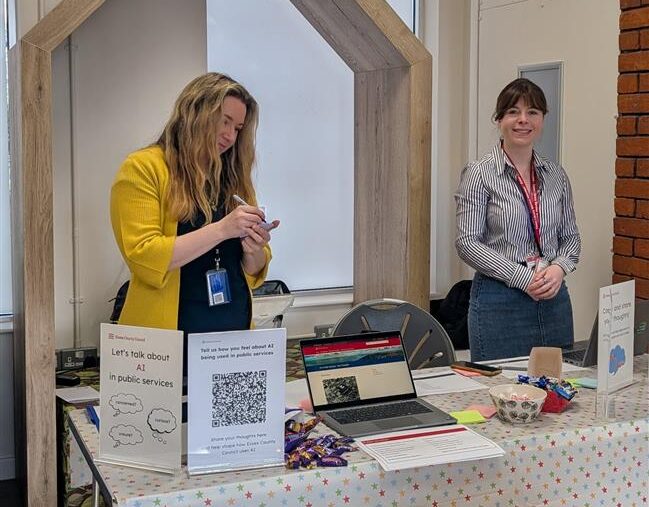
Last week, we spent two days in different libraries in Essex, trebling the number of voices we had heard from so far. Equipped with chocolates as (a bribe) an incentive to sit and chat with us, as well as with smiles and comfortable chairs, we took residents through a short survey and collected their spoken-out-loud thoughts as well.
Hearing the full spectrum of voices
We spoke to young students and nonagenarians. We spoke to people using the library as a warm place to spend the day. We spoke to an incredibly insightful young man who was using the library as a place to meet his support worker. We spoke to a woman who arrived in England 50 years ago and worked for the NHS ever since, who told us she’s keen to understand AI as “the world is always changing, and we need to change with it.”
We spoke to parents of tiny babies, and read books to toddlers as their parents independently took themselves through our survey. We spoke to university professors, IT professionals, and job seekers. Using the magic of AI translation tools, we spoke to Essex residents who are learning English, and keen to voice their opinions about AI.
It’s safe to say that most of the people we spoke to would never have stumbled across our online recruitment calls.
“I ransack public libraries, and find them full of treasure.” – Virginia Woolf
Now, this research wouldn’t have been complete if we’d only done our research by stopping unsuspecting residents in libraries for a chat. Those more intentional, in-depth explorations through one-to-one interviews form a crucial backbone of the research study. But mixed methods research should really be the gold standard, and what we should be aiming for to get a full understanding of the spectrum of opinions.
By placing ourselves in libraries, we truly heard the voices of the community, and we heard their curiosities and concerns about AI loudly and clearly. We also had people queuing up to talk to us, and had people thank us for their opportunity to contribute to what they felt was important work.
As user centred designers who want to ensure that our products and services are fully informed by the user voice, we have to sometimes step away from the world of remote research sessions which we’ve become so reliant on. We have to meet our users, our research participants, our residents, where they are; you’ll find them in the library.
Thanks to the people that made it happen
Huge thanks to not only the residents who stopped for a chat, to Louise Wheeler, May Jorge and Dani Spinage who made up the research team, but also to Chris Watson-Lee, Judith Wickenden, Andy Jackson, Richard Knight and Stephanie Pemberton – superstars of Essex Library Services who not only made it possible for us to do this research in the first place, but who make Essex libraries the incredible community resources that they are.
1 comment
Comment by Caroline McCabe posted on
Libraries are 100% GOLD for user research! Back when I became a content designer, we didn't have the luxury of having user researchers in our team. So we'd rock up in the library and tempt people with chocolate bars in a basket. Always found willing and interesting participants 🙂